 Weather24
Migraine & arthritis weather forecast: how Weather24 rates today’s weather load
In short: no app can forecast a migraine — but it can forecast the weather that studies link to headaches and joint pain: a fast pressure drop ahead of a front, humid air after dry days, big temperature swings. The Weather24 app scores these factors for your location every hour on a 0–10 scale and tells you why.
Meteo-sensitivity hour by hour for your location, with the reasons — in the Weather24 app.
What weather-sensitive people actually feel
Plenty of people say they can feel the weather coming — headaches, joint pain, fatigue, poor sleep. Research is cautious, but four weather factors keep showing up:
Especially when damp air arrives after dry days.
UK study “Cloudy with a Chance of Pain”, 2,658 participants.
Migraine attacks clustered at drops of 6–10 hPa (≈0.2–0.3 inHg); a fast fall hits harder than a slow one.
Japanese studies (Okuma 2015, Kimoto 2011), small groups.
Big changes over 1–3 days, including the felt temperature — like the cold wind behind a front.
Low pressure together with stronger wind — weaker than humidity, but measurable.
This is weather information, not medical advice. If symptoms are severe or new, talk to a doctor.
How the Weather24 app rates the weather load
- Four factors, not one. The app scores humidity, low pressure with wind, temperature swings and pressure change — the same factors as in the studies above.
- Compared with your normal. Everything is measured against what is usual where you are: pressure against the 30-day average, humidity against the days before.
- Fronts ahead of time. When pressure starts falling and rain follows, the app spots an approaching front — before the rain, which is when weather-sensitive people feel it. The card then says something like “front approaching, rain in 3 h”.
- A 0–10 score, every hour. The strongest factor sets the score and each other noticeable factor adds to it, because coinciding factors are the hardest. Below 4 is “Low risk”, from 4 “Moderate risk”, from 7 “High risk”.
- With the reasons. Instead of a bare number you see why: “pressure falling by 0.24 inHg”, “humidity jumped to 92%”, “temperature swing 16°”.
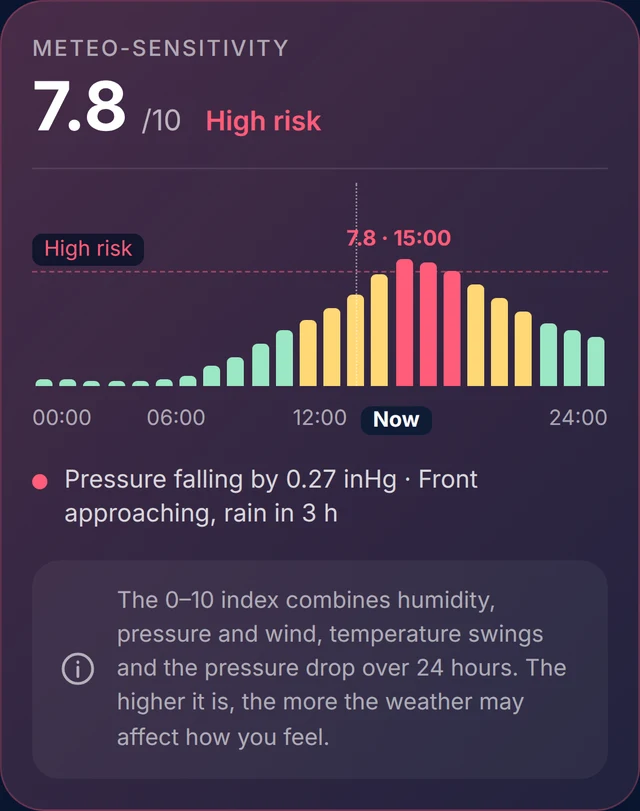
Check once in the morning. The hourly curve shows when today’s weather load peaks, so you can plan around it.
Pressure, made simple
Sea-level pressure in the US usually sits between about 29.5 and 30.5 inHg (999–1033 hPa); the standard is 29.92 inHg (1013 hPa). A single reading says little — what matters is direction and speed. A drop of 0.09 inHg (3 hPa) or more in three hours counts as fast and usually means a front is on its way. In the app you get the Pressure over the day chart, the Rapid pressure drop warning and a pressure map layer with highs and lows.
Meteo-sensitivity in the Weather24 app
The Meteo-sensitivity card shows hour by hour how hard today’s weather is on weather-sensitive people and why — humidity, pressure change, wind and temperature swings. Plus pressure over the day and a Rapid pressure drop warning.
Frequently asked questions
Is the barometric pressure affecting people today?
Is there a migraine weather forecast?
What barometric pressure causes headaches?
How does the Weather24 app calculate meteo-sensitivity?
See also: Rain radar · Lightning map · Weather by city