 Weather24
Solar storm today: Kp index and 3-day forecast
In short: a solar storm today becomes a geomagnetic storm once the Kp index reaches 5 or more (level G1). Below are the current value and NOAA’s forecast for the next three days, refreshed every 30 minutes — plus how far south in the U.S. the aurora could reach tonight.
Today’s Kp index in the “Geomagnetic storms” card — in the Weather24 app.
What a solar storm is — and what the Kp index measures
Every so often the Sun throws out clouds of charged particles (coronal mass ejections), and coronal holes send out streams of fast solar wind.
When one of them reaches Earth — usually one to three days later — it shakes up the planet’s magnetic field. That is a geomagnetic storm, and its strength is measured with the Kp index from 0 to 9, calculated every three hours from magnetometers around the world.
Despite the name, a geomagnetic storm today brings no rain, wind or lightning — it happens in Earth’s magnetic field. For thunderstorms, check the live lightning map; for clouds and rain before an aurora night, the rain radar.
The G1–G5 scale and where the aurora shows up in the U.S.
| Kp | Level | What it means |
|---|---|---|
| 0–3 | quiet | undisturbed field; aurora mostly in Alaska |
| 4 | unsettled | minor disturbances, no storm |
| 5 | G1 · minor | weak power grid fluctuations; aurora in northern Michigan and Maine |
| 6 | G2 · moderate | aurora as low as New York and Idaho |
| 7 | G3 · strong | GPS errors and radio problems; aurora as low as Illinois and Oregon |
| 8 | G4 · severe | grid and satellite problems; aurora as low as Alabama and northern California |
| 9 | G5 · extreme | widespread grid issues; aurora as low as Florida and southern Texas |
This is NOAA’s Space Weather Scale. G1 storms happen many times a year, G5 only a few times per solar cycle.
In May 2024 the first G5 storm in more than twenty years painted the sky across much of the country, with photos reported from the Deep South. The aurora lines are rules of thumb: you also need darkness, clear skies and a view to the north away from city lights. Cloud bands show up on the radar, for example the rain radar for Chicago.
Geomagnetic storms and how you feel
Many people link their bad days to solar storms. Studies, however, are few, done on small groups and inconsistent — there is no confirmed mechanism by which magnetic field disturbances would affect the body.
The link with changes in barometric pressure and humidity is much better described — more on that in our migraine weather forecast article.
Check it for yourself. If you keep a symptom diary, write down the Kp index next to barometric pressure and its 24-hour change. After a few weeks you’ll see whether there’s any pattern in your case.
This is space weather information, not medical advice. If you have severe or new symptoms, talk to your doctor.
Geomagnetic storms in the Weather24 app
- The “Geomagnetic storms” card among the cards on the Forecast screen shows today’s Kp index. Free.
- A 24-hour chart. In Pro the card opens into a chart for the whole day, so you see when the storm is expected, not just that it’s coming.
- Right next to barometric pressure and Meteo-sensitivity — everything weather-sensitive people check in the morning, on one screen. Meteo-sensitivity is in Pro.
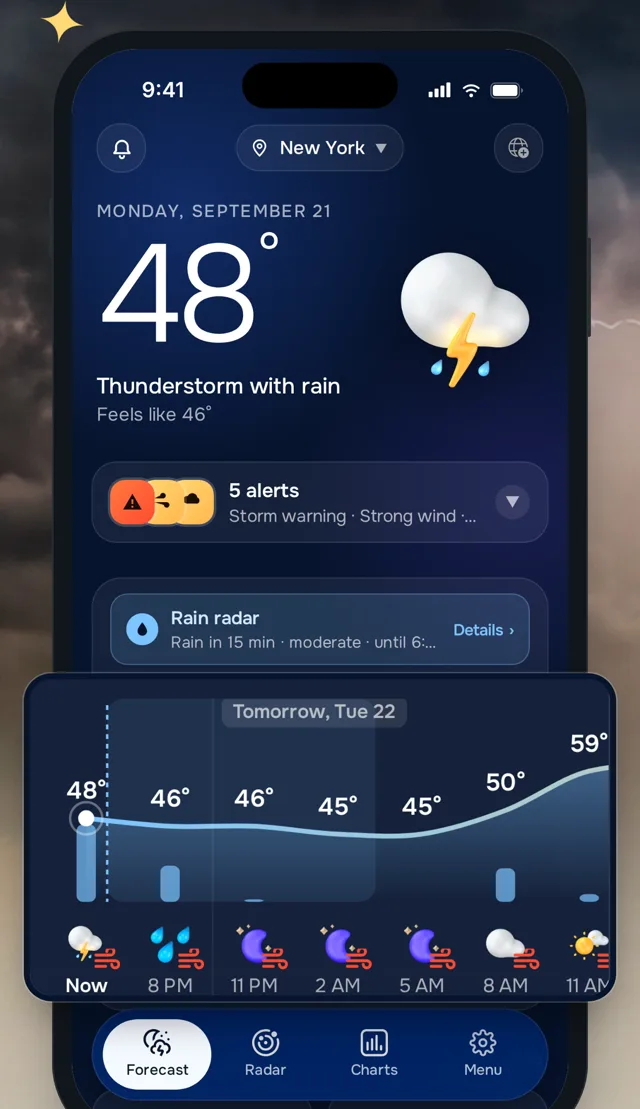
Geomagnetic storms in the Weather24 app
The “Geomagnetic storms” card shows today’s Kp index for free. In Pro the card opens into a 24-hour chart — right next to the barometric pressure and Meteo-sensitivity cards.
Frequently asked questions
Is there a solar storm today?
What is the Kp index?
Is a solar storm the same as a geomagnetic storm?
What Kp do I need to see the northern lights in the U.S.?
Can a geomagnetic storm cause headaches?
See also: live lightning map · rain radar · rain radar New York
Also worth knowing
What Is a Good AQI? The 0–500 Air Quality Scale Explained
What the EPA air quality index levels mean, which pollutant drives the number, the AQI in major US cities right now and how the Weather24 app shows air quality for your location.
November 3, 2026 →Best Barometric Pressure for Fishing: Read the Trend, Not the Number
Why a falling barometer often means a better bite, what counts as high and low pressure in inHg, where pressure is changing across the US right now and how to track it in the Weather24 app.
November 2, 2026 →Migraine & Arthritis Weather Forecast: How Weather24 Rates Today’s Weather Load
Which weather changes studies link to headaches and joint pain, where barometric pressure is swinging today, and how the Weather24 app scores meteo-sensitivity hour by hour.
November 1, 2026 →