 Weather24
Lightning distance calculator Seconds ÷ 5 = miles
In short: this lightning distance calculator runs on a simple fact: every 5 seconds between flash and thunder puts the lightning about a mile away, so a 10-second count means roughly 2 miles and 25 seconds about 5 miles. It is an estimate; the exact distance to the nearest strike is on the lightning map.
An alert when lightning strikes within 10–50 km (about 6–30 miles) of you — in the Weather24 app.
The 5-second rule: where it comes from
You see the flash practically the instant lightning strikes — light is almost a million times faster than sound. Thunder travels at roughly 1,100 feet per second, which works out to about a mile every 5 seconds. Hence the simple rule: seconds ÷ 5 = miles. (If you think in kilometers, it’s seconds ÷ 3.)
| Flash to thunder | 5 sec | 10 sec | 15 sec | 25 sec | 50 sec |
|---|---|---|---|---|---|
| Distance | ~1 mi | ~2 mi | ~3 mi | ~5 mi | ~10 mi |
Why the count is only an estimate
- The speed of sound depends on temperature — a little slower in cold air, but only by a few percent.
- It’s not always clear which thunder goes with which flash — when lightning is frequent, it’s easy to mix them up.
- Thunder rarely carries much beyond 10 miles; farther storms show up only as silent flashes.
- Lightning can strike far from the rain — bolts from the edge of a thunderstorm can land miles away from the downpour, out of what looks like a clear sky.
That last point is why the familiar rule is “When thunder roars, go indoors” — hearing thunder already means you are within reach.
Lightning distance in the Weather24 app
- Distance without counting. Every symbol on the map sits where the Blitzortung detection network located the strike, so you can see how far away the lightning is — at night, in traffic noise, anywhere.
- Storms in the hours ahead. The thunderstorm layer shows the forecast on the map, from now out to 48 hours.
- The “Lightning nearby” alert. Pick a radius from 10 to 50 km (about 6–30 miles); the app checks every 3 minutes and lets you know when lightning hits closer than that.
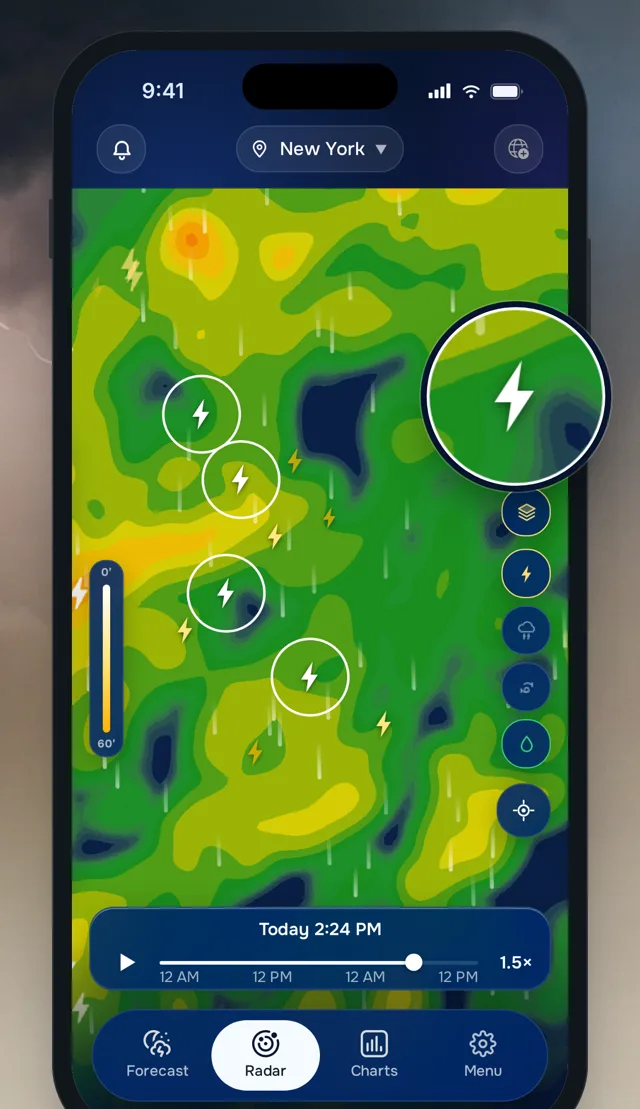
Live lightning on the map and the “Lightning nearby” alert are part of Weather24 Pro. On the web, the same strikes are on our live lightning map, with pages for metros such as Chicago and Houston.
If you can hear thunder, you’re within striking distance. The “Lightning nearby” alert in the app comes before the storm is overhead.
Lightning distance in the Weather24 app
The app shows lightning strikes around you on the map and sends a “Lightning nearby” alert when lightning hits inside the radius you choose, from 10 to 50 km (about 6–30 miles) — no counting required.
Frequently asked questions
How do you calculate how far away lightning is?
How far away can you hear thunder?
Is the storm coming toward me?
Is there a lightning distance calculator app?
How close is too close?
See also: live lightning map · lightning strikes New York · rain radar
Also worth knowing
Normal Barometric Pressure: What’s Normal in inHg and hPa
Normal barometric pressure is 29.92 inHg at sea level, but your reading depends on altitude. What range is normal, why Denver reads lower and how the Weather24 app shows today’s pressure.
November 7, 2026 →What Is Considered High Barometric Pressure? A Simple Chart
High, normal and low barometric pressure in inHg and hPa, what each means for the weather, how to read a barometer and where pressure is highest and lowest in the US right now.
November 6, 2026 →When Will It Stop Raining? Check It to the Quarter Hour
How the Weather24 app works out when the rain ends from a 15-minute precipitation forecast, which weather models it uses in the US and when the end-of-rain estimate can be off.
November 6, 2026 →