 Weather24
UV index scale: what each level means
In short: on the UV index scale, Florida and Arizona regularly reach 11+ in summer, while by November most of the US drops to 1–3. 0–2 is low and needs no special protection; from 3 sun protection is recommended and from 8 extra protection.
The UV index for your exact location — in the Weather24 app.
Only 0–2 is low: the UV index scale level by level
The UV index is an international scale set by the World Health Organization with other UN agencies, and the EPA uses the same levels in the US. The higher the number, the faster unprotected skin can burn.
| UV index | Level | What the scale recommends |
|---|---|---|
| 0–2 | low | no special protection needed |
| 3–5 | moderate | protection needed: shade around midday, clothing, hat, sunglasses, sunscreen |
| 6–7 | high | the same measures, none skipped |
| 8–10 | very high | extra protection: avoid the midday sun, seek shade |
| 11+ | extreme | extra protection, no exceptions |
So which UV index is safe? Only 0–2 needs no special protection. The number in a forecast is the daily maximum around solar noon; early morning and late afternoon are much lower.
Sun angle, altitude and snow push the number up
- Sun angle. The main factor — that is why the UV index depends on the time of day, the season and how far south you are. Miami sits about 16° of latitude south of Boston.
- Clouds. Thin or scattered clouds let much of the radiation through; a hazy summer day can still be high.
- Elevation. UV rises by roughly 10% for every 1,000 m (about 3,300 ft). Denver, at 5,280 ft, gets noticeably more than a city at sea level at the same latitude — and the Rockies more still.
- Snow, sand and water. Fresh snow reflects up to 80% of UV, dry sand around 15%. That is why skiers in Colorado get sunburned on cold days.
Across the US: 11+ in Arizona, 1–3 up north in November
Miami and Tampa sit far south; on clear days from May to August the maximum is very high or extreme.
Even in November, 5–6 is common.
Clear desert skies and a high sun put Phoenix among the highest UV in the lower 48 in June and July.
Spring and fall are still high.
The altitude adds about 15% compared with sea level; mountain trails add more.
Snow in spring can push it up while it still feels cold.
New York, Chicago, Boston and Seattle: the sun is low and the UV index is low to moderate at best.
Summer in the same cities: around 7–9.
These are rough values for clear days; today’s maximum for each city is at the top of the page. For showers and monsoon storms, check the Phoenix rain radar or the Denver rain radar; more places are under weather by city.
The Weather24 app shows the UV index for free
- UV index card among the Today cards on the Forecast screen: the UV index for your location. Free.
- 24-hour chart in Pro: the expanded card shows how the UV index changes through the day.
- UV row in the 48-hour chart — also in Pro, alongside pressure, humidity and other rows.
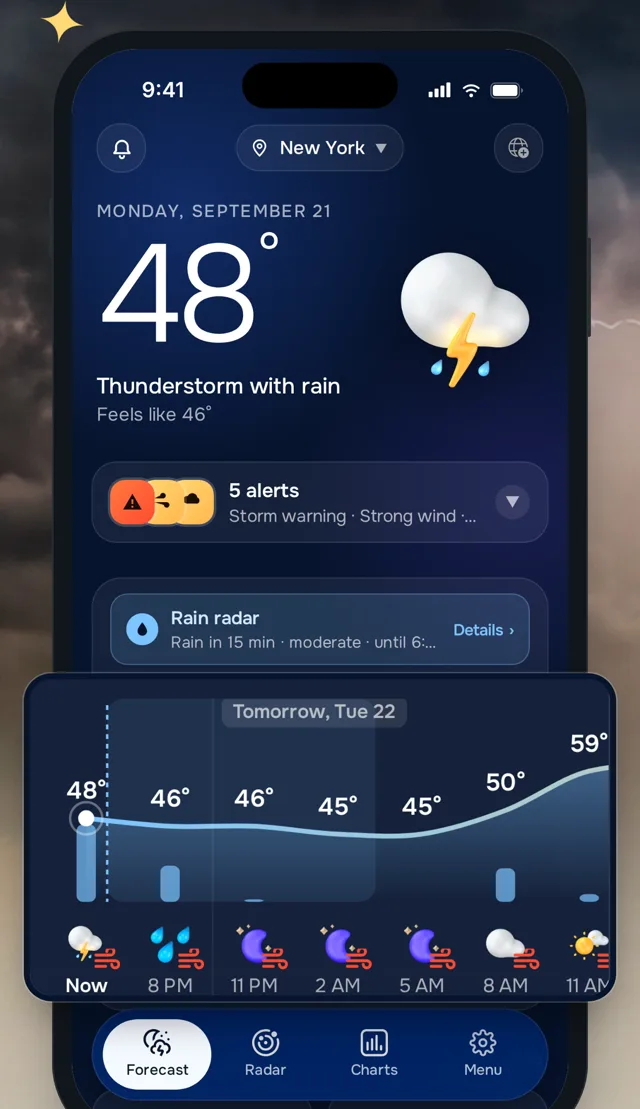
- All on one screen: temperature, wind, air quality and the rain radar.
Remember the number 3. From a UV index of 3 the scale calls for sun protection — in the southern US that is most days of the year, in the north mostly spring and summer.
This is weather information, not medical advice. If you have very sensitive skin, take medication that makes you sensitive to sunlight or have questions, ask your doctor or pharmacist.
The UV index in the Weather24 app
The UV index card shows today’s value for your location, next to your forecast, air quality and rain radar. Pro adds the expanded 24-hour chart and a UV row in the 48-hour chart.
Frequently asked questions
What is a good UV index?
What UV index is dangerous?
Is a UV index of 6 high?
What time is the UV index highest?
Can you get UV exposure on a cloudy day?
See also: UV index today · Rain radar · Lightning map · Weather by city
Also worth knowing
Lightning Distance Calculator: Count Seconds, Divide by 5
Count the seconds between flash and thunder and divide by 5 to get the distance in miles. A quick table, why it is only an estimate and how the Weather24 app shows the nearest strike.
November 8, 2026 →Normal Barometric Pressure: What’s Normal in inHg and hPa
Normal barometric pressure is 29.92 inHg at sea level, but your reading depends on altitude. What range is normal, why Denver reads lower and how the Weather24 app shows today’s pressure.
November 7, 2026 →What Is Considered High Barometric Pressure? A Simple Chart
High, normal and low barometric pressure in inHg and hPa, what each means for the weather, how to read a barometer and where pressure is highest and lowest in the US right now.
November 6, 2026 →